
Holding Fast and Moving Faster: Understanding the Current State of EV Technology
An overview of EV battery and material evolution and the opportunities therein
EVs Are No Longer Experimental
After years of marginal growth, the electric vehicle (EV) market has entered the mainstream. More buyers than ever are considering electric cars and trucks to replace the internal combustion engine (ICE) vehicles that defined American culture and commerce for more than a century.
From Experimentation to Standardization
Every aspect of motor vehicle manufacturing and use began as an experiment, evolved through competition, and matured as a standard. From fuel types to safety standards to road signs, cars and trucks converged into a relatively narrow range of body designs and functional options. The EV market has inherited most of those standards but must also develop some of its own.
EV Types and Power Sources
The primary power source of a hybrid electric vehicle is an ICE, with the battery as reserve power. A plug-in hybrid electric vehicle uses a battery first and an ICE second. It can be charged with AC power. And a battery-electric vehicle has no ICE at all. That means drivers need to limit their range to one charge before returning home or know where to find a charging station.
Charging Systems and Infrastructure Choices
In turn, manufacturers need to decide whether to adopt a standard charging system or try to build a brand-specific infrastructure. As more makers enter the marketplace, a common standard becomes increasingly practical. It allows new arrivals to piggyback on a system others already built and reduces the cost to customers of switching brands. Consumer expectations are inelastic; they have created the demand for a uniform charging interface. Further changes are likely to be incremental.
Battery Engineering Takes Center Stage
The other side of evolving battery technology is engineering, where innovation takes a higher priority than consumer preferences. Manufacturers are pursuing higher capacities for longer driving ranges, faster charging for competitive marketplace advantage, weight reduction for performance improvement, and so on. As long as the charging system works, anything goes.
New Manufacturing Opportunities Across the Supply Chain
Manufacturing has opportunities, too. From raw materials suppliers and unit cell manufacturers to battery packers and OEMs, everyone is looking for potential process improvements that can make assembly more efficient or later servicing more convenient. Research and development are continuous, even with established designs and power plants already in production.
What does this mean for manufacturing and research and design? Engineering teams with integrated fabricators that work in tandem with their vision can move faster and pivot sooner. Working with suppliers better insulated from global distributions yet still adept at ideation and material selection and manipulation will be a key differentiator for bringing improvements to market more rapidly.
What’s Inside an EV Battery?
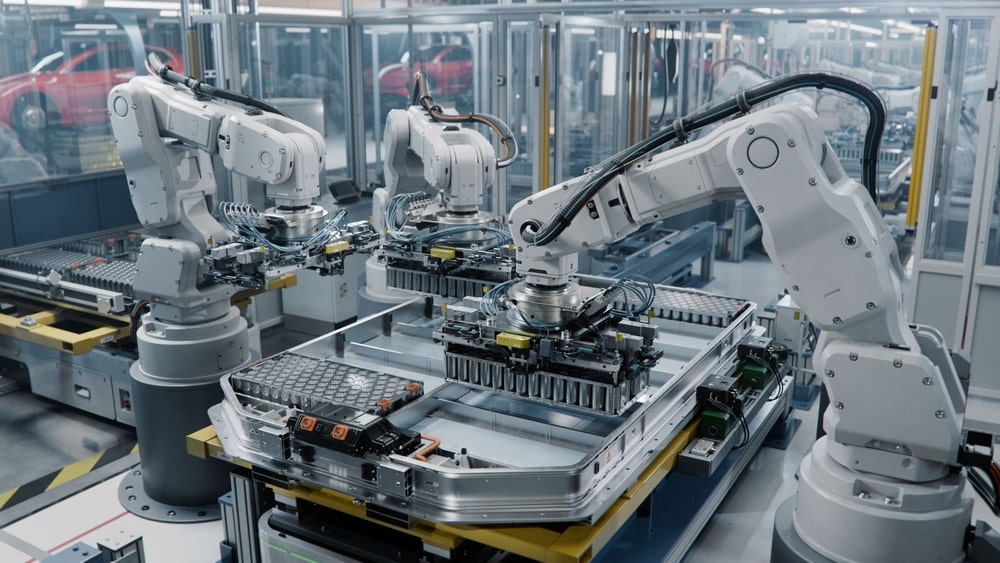
Most EVs are powered by lithium-ion battery packs made up of several battery modules, each of which contains multiple battery cells. The individual cells may be as small as household batteries, and the entire battery pack can fill the chassis from axle to axle and door to door. Some vertically integrated EV manufacturers make their own batteries; others buy them as components from Tier 1 suppliers.
Why Lithium-Ion Is the Current Standard
In general, lithium-ion batteries offer higher energy density and lower weight than lead-acid or nickel metal hydride batteries with the same output. They also discharge more slowly; some EVs with lithium-ion batteries have a claimed range of 500 miles—farther than most ICE vehicles can travel on a single tank of fuel.
Designing for Disassembly and Sustainability
One drawback of lithium-ion batteries is that they are difficult to disassemble for reclamation or recycling, and simply discarding them creates environmental hazards. However, the EV battery recycling market is rapidly expanding and poised for exponential growth. Many EV buyers cite reduced impact on the natural world as a leading motivation, so this is a challenge for both practical purposes and public perception. It may also be an opportunity for the use of adhesives that can be removed neatly when an EV is disassembled.
Where Adhesives, Sealants, and Gaskets Matter Most

Manufacturers use adhesives, gaskets, sealants, and thermal materials throughout an EV—especially in battery packs. Heat transfer materials can be made from economical polyurethanes and silicones, while durable epoxies, acrylics, and polyurethanes can be used as structural adhesives within and among battery subassemblies. Where thread locking or thread sealing is needed, cyanoacrylates and anaerobics are sound choices. According to estimates from Industrial Market Insight, the average EV uses nearly 8 pounds of adhesives and sealants between the battery and motor.
Engineering for Protection, Performance, and Longevity
Battery cells, modules, and packs present special technical challenges. They must be arranged in dense groups for efficiency but need protection against overheating. They need to be isolated from liquids, like environmental moisture and fluids used by the vehicle. And they need shock absorption to minimize risks of mechanical failure.
The Opportunity for Material Innovation
An article in Adhesives & Sealants Industry (ASI) magazine says, “The electric vehicle market represents a tremendous growth opportunity … Adhesives, sealants, and heat transfer materials used in battery assembly operations will find myriad opportunities in this exciting market.”
The inverse is also true—that OEMs and Tier 1 suppliers in the EV industry will find innovation and opportunity among the leading converters that specialize in automotive adhesives.
To learn more about sealing and gasketing within the automotive and EV space or to discuss engineered solutions for unique problems, reach out to our experts!